7 Cake Pricing Mistakes That Cost Bakers Money
These 7 cake pricing mistakes quietly drain your profits on every order, from forgetting overhead to confusing markup with margin. Fix them now.
Quick Answer: The most damaging cake pricing mistakes are forgetting overhead, not charging for labor, underestimating time, discounting for friends, ignoring design complexity, skipping price increases when ingredient costs rise, and confusing markup with margin. Each one eats into profit on every order.
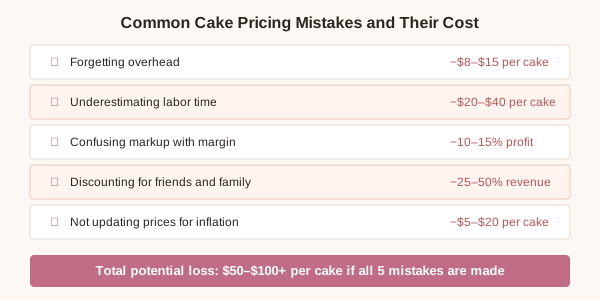
Cake pricing mistakes are almost never obvious in the moment. You quote a price that feels reasonable, the client says yes, you bake the cake, and it looks great. Then you add up what the order actually cost you and realize you made $4 an hour.
These seven mistakes show up constantly, in home bakeries, cottage businesses, and even established shops. Most of them are fixable once you see them clearly.
Mistake 1: Forgetting Overhead Entirely
Overhead is the portion of your operating costs that doesn't belong to a single cake but still gets consumed every time you bake. Electricity, parchment paper, piping bags, packaging, a share of your mixer depreciation, your cottage food license renewal. All real costs.
Bakers who forget overhead think their profit is (sale price − ingredients). The real number is (sale price − ingredients − overhead − labor). Skip overhead and you're subsidizing every customer's cake out of your own pocket.
The fix: Track every non-ingredient baking expense for one month. Divide that total by the number of cakes you made. That's your per-cake overhead charge. Add it to every quote. For most home bakers, it runs $4–$8 per cake.
Mistake 2: Not Charging for Your Labor
This is the most common mistake and the most expensive one. Many home bakers count ingredients, maybe overhead, and then set a price that "feels fair," leaving their own time completely uncompensated.
Your labor is not free. You are performing skilled work: measuring, mixing, baking, cooling, filling, frosting, decorating, boxing, and communicating with clients. Every hour of that work has a dollar value.
The fix: Set an hourly rate. A beginner rate of $15–$18/hour is reasonable. An experienced decorator should charge $22–$30/hour. Track your actual time on an order (bake to delivery) and bill it at your rate. Then use our cake pricing calculator to build that labor into your final price automatically.
Mistake 3: Underestimating How Long a Cake Takes
You think the birthday cake with the buttercream garden will take three hours. It takes five. You budgeted $54 in labor; you spent $90. The difference comes straight out of your margin.
Time underestimation is especially bad with complex designs. First-time designs, new techniques, and any order with hand-crafted sugar elements almost always take longer than the mental estimate.
The fix: Time yourself on real orders for one month. Keep a log. You'll find patterns quickly: your standard 8-inch takes exactly 3.25 hours, your fondant cakes take at least 5. Use actual data, not optimistic guesses, when quoting.
Mistake 4: Discounting for Friends and Family
"I'll just charge you for ingredients" is one of the most expensive sentences a baker says. It trains people in your circle to see your work as a favor rather than a service. And word spreads, until suddenly acquaintances are messaging you expecting the same deal.
Gifting a cake is generous and entirely your choice. But discounting a cake is different. You're working just as hard for less money, and you're setting an expectation that will cost you every future interaction.
The fix: Pick one of two positions and stick to it. Either charge your full rate (and explain that you price this way for everyone), or gift the cake as a genuine gift: make it clear it's your treat, not a discounted service. Never half-price a cake as if it were normal business.
Mistake 5: Ignoring Design Complexity in Your Quote
A flat quote per cake size doesn't work. A smooth 8-inch buttercream cake takes 2 hours. The same size cake with hand-painted floral panels, edible gold leaf, and a piped lace border takes 6 hours. If both are quoted at the same price, the complex cake is losing money.
Complexity isn't just decoration. It includes: number of tiers, flavor variations, interior fill layers, frosting type (fondant adds significant labor), structural requirements (doweled stacks, carved shapes), and any custom elements made from scratch.
The fix: Build complexity into your labor estimate, not into a vague "premium" surcharge. Count the actual extra hours and charge for them. If you're unsure, the wedding cake pricing guide walks through how to tier your pricing by design complexity.
Mistake 6: Not Updating Prices When Ingredient Costs Rise
Butter prices can shift 20–30% in a single quarter. Eggs jumped dramatically in 2023–2024. Vanilla extract fluctuates year to year based on global supply. If your pricing was set 18 months ago and you haven't reviewed it since, inflation has been quietly cutting your margin on every order.
Many bakers avoid raising prices because they fear losing customers. But keeping prices frozen while costs rise means you're earning less per order in real terms every month.
The fix: Review your ingredient costs every 60–90 days. When a core ingredient goes up meaningfully (5% or more), recalculate your base recipe costs and adjust your prices accordingly. A $3–$5 price increase on a $90 cake is almost never a customer relationship problem, but it's a meaningful margin improvement across 20 orders a month.
Mistake 7: Confusing Markup With Margin
These two terms sound interchangeable but they produce very different numbers, and mixing them up leads to underpricing.
Markup is calculated on cost: a 25% markup on a $60 cost gives a price of $75.
Margin is calculated on the sale price: a 25% margin on a $75 sale means $18.75 profit, so cost was $56.25.
If you want a 25% profit margin and you apply 25% as a markup instead, your actual margin is only 20%. On a $60 cake, that's $3 less profit per order. At 25 orders a month, that's $75/month in lost profit, which adds up to over $900 a year.
The fix: Decide which metric you're using and be consistent. Most food businesses target profit margin (not markup). To hit a 25% margin, use the formula: Sale Price = Cost ÷ (1 − 0.25) = Cost × 1.333. At $60 cost, that gives a $80 sale price, not $75.
You can see this calculation laid out clearly when you run your numbers through the pricing calculator. It applies margin correctly so your output reflects real profit.
Why These Mistakes Compound
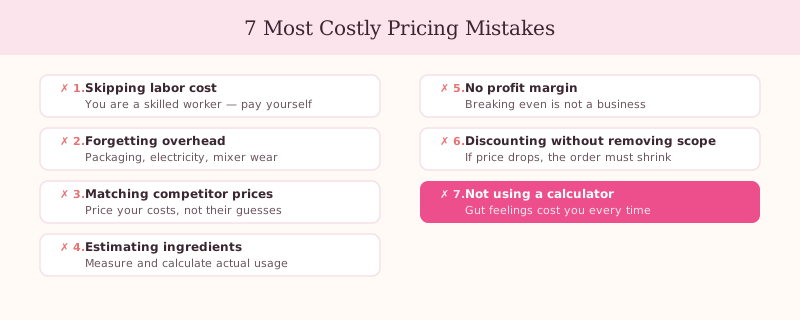
None of these mistakes exist in isolation. A baker who forgets overhead, underestimates time, and applies markup instead of margin is losing money three ways at once on every order. The result feels like "cake business is just hard" when really it's a pricing system that has three leaks in it.
Once you patch these individually, pricing stops being stressful. You know your number. You can quote confidently. And you can take on more work without wondering if more orders actually means less money.
Read the full guide to pricing a cake as a home baker for a step-by-step walkthrough of building a price from scratch, from ingredients through margin. And learn more about the people behind this tool if you want to understand how the calculator methodology was developed.