How to Price a Cake as a Home Baker
Learn how to price a cake correctly as a home baker, covering all 4 cost components with a real birthday cake example and customer scripts.
Quick Answer: To price a cake as a home baker, add up your ingredient costs, overhead, and labor, then apply a profit margin. Most home bakers undercharge because they skip labor or overhead entirely. A correctly priced 8-inch birthday cake often runs $75–$110.
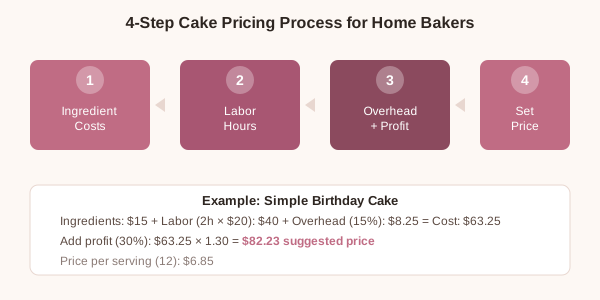
Knowing how to price a cake is the skill that separates home bakers who build real businesses from those who burn out giving their work away. If you've ever finished a three-hour decorating session and wondered whether you made anything, this walkthrough is for you.
Why Undercharging Hurts More Than It Helps
Charging too little feels safe at first: you get orders, clients are happy, and you tell yourself you'll raise prices once you have more experience. But undercharging has a compounding cost.
Every order you fill below true cost trains your customers to expect low prices. It makes raising rates later feel like a betrayal. It also signals to the market that your work isn't worth much, even when the cakes are genuinely excellent.
Worse, it's just not sustainable. If you're spending $60 in ingredients and 4 hours of time to sell a cake for $50, you're not running a business: you're paying someone else to eat your cake.
The fix isn't to guess at a "fair" number. It's to build your price from the ground up using the four cost components every professional baker accounts for.
The 4 Cost Components of Cake Pricing
1. Ingredient Cost
This is every consumable that goes into the cake. Flour, butter, sugar, eggs, milk, flavoring, food coloring, fondant, edible decorations. If it gets used up making the order, it counts.
The most common mistake: estimating instead of measuring. Weigh your ingredients and look up the cost per gram or ounce based on what you actually paid. Eyeballing is how you end up eating a $3 undercount on every order.
2. Overhead
Overhead covers the costs of running your baking operation that aren't tied to a single cake. Think: a portion of your monthly electricity bill, parchment paper, piping bags, packaging (boxes, boards, ribbon), and equipment depreciation.
A simple method: track your monthly overhead costs for one month, divide by the number of cakes you produced, and add that per-cake overhead to every order. For most home bakers, this runs $4–$8 per cake.
3. Labor
Your time has value. This surprises some home bakers, but it shouldn't. You are performing skilled work (baking, finishing, decorating) that takes training and practice. You should pay yourself for it.
Set an hourly rate and track every minute: prep, bake time (even if you're not actively working), decorating, cleanup, and any time spent on client communication or delivery. Charge for all of it.
Most home bakers starting out should charge at least $15–$20/hour. If you have strong decorating skills or specialized training, $25/hour is entirely reasonable.
4. Profit Margin
Profit margin is what pays for new equipment, covers mistakes, and funds business growth. This is not the same as your labor rate: it's a percentage applied on top of all costs.
A standard approach: add 15–25% to your total cost before ingredient, overhead, and labor. Twenty percent is a common starting point for home bakers.
Step-by-Step: Pricing a Real Birthday Cake
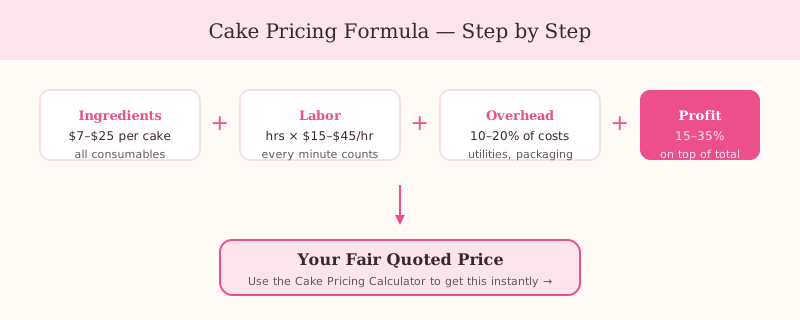
Let's price a two-layer 8-inch vanilla birthday cake with strawberry filling and buttercream frosting, plus piped lettering and some decorative swirls.
Step 1: Ingredient cost:
| Item | Amount Used | Cost |
|---|---|---|
| All-purpose flour | 300g | $0.42 |
| Granulated sugar | 280g | $0.56 |
| Unsalted butter | 250g | $2.25 |
| Eggs | 4 large | $1.20 |
| Whole milk | 180ml | $0.22 |
| Vanilla extract | 2 tsp | $0.80 |
| Strawberry preserves (filling) | 120g | $0.90 |
| Powdered sugar (buttercream) | 400g | $0.88 |
| Food coloring | small amount | $0.30 |
| Total | $7.53 |
Step 2: Overhead:
Box, cake board, ribbon, piping bags, parchment, electricity share: $5.50
Step 3: Labor:
- Prep and bake: 1.25 hours
- Cool time (you're not working, but the oven is): 0.25 hours billed
- Filling, crumb coat, final coat: 1.5 hours
- Lettering and swirl decoration: 0.75 hours
- Cleanup: 0.5 hours
- Total: 4.25 hours × $18/hr = $76.50
Step 4: Subtotal before margin:
$7.53 + $5.50 + $76.50 = $89.53
Step 5: Add 20% profit margin:
$89.53 × 1.20 = $107.44
Final quoted price: $107
Use our cake pricing calculator to run this same calculation for your specific inputs. It handles the math instantly so you can price confidently.
How to Communicate Your Price to Customers
Most home bakers dread the moment a client asks "how much?", especially when they know the answer is higher than a grocery store sheet cake.
Keep it simple and confident. You don't need to justify every line item, but having the breakdown in your head means you won't second-guess yourself mid-conversation.
A good formula: state the price, then briefly explain what it includes.
"This cake will be $107. That covers a two-layer 8-inch vanilla cake with strawberry filling, fresh buttercream, and your custom lettering. Everything is made from scratch and packaged in a presentation box."
That's it. No apology, no hedging, no "I know it seems like a lot." You made something from scratch with your hands and your skill: the price reflects that.
What to Do When Someone Says "That's Too Expensive"
This happens. And it stings. But "that's too expensive" is rarely the end of the conversation.
Option 1: Offer a scaled-down version. A single-layer 6-inch version of the same cake might come in at $65–$75. Offer it as an alternative without apologizing for the original quote.
Option 2: Explain what's included. Sometimes sticker shock comes from customers comparing your scratch-made cake to a supermarket product. "That price includes four hours of work, premium ingredients, and custom decoration. It's a handmade product, not mass-produced."
Option 3: Decline politely. Some customers are simply not your target market. That's fine. "I understand. My pricing reflects the time and ingredients involved. I hope you find something that works for your budget."
What you should never do: cave and drop your price without removing something from the order. If you drop the price, drop a tier, remove a decoration element, or reduce the size. Your costs don't disappear because a customer pushed back.
Read more about the specific traps that cost bakers money in the 7 cake pricing mistakes to avoid post: it covers the most common ways bakers undercut themselves.
Setting Prices You Can Actually Defend
The goal isn't to find the number customers will accept. It's to find the number that makes the business work, and then communicate it with confidence.
Once you've run the four-component calculation a few times, pricing becomes automatic. You'll know your typical ingredient costs for your most common cake sizes. You'll know your overhead per order. You'll know your hourly rate and roughly how long each style takes.
That knowledge is what lets you quote quickly, accurately, and without second-guessing. That's what professional bakers (home-based or commercial) do every time.
Start by running a few sample cakes through our free cake pricing tool to see where your current prices stand relative to a fully-loaded cost calculation. You might be surprised how far off the mark a gut-feeling price can be.
Learn more about how custom cake pricing compares across styles and markets for additional context on what the market supports in your area. And if you're also curious how your wedding cake rates stack up, the wedding cake pricing guide covers the full event-cake picture.
Find out more about the team behind this tool and how the calculator formula was built.