Tiered Cake Pricing: How to Charge for Multi-Tier Cakes
Tiered cake pricing requires more than stacking single-tier costs. Learn how complexity, support hardware, assembly, and transport risk should all affect what you charge.
Quick Answer: Tiered cake pricing should include a complexity multiplier on top of per-tier ingredient and labor costs. A two-tier cake is not twice the price of one tier: the structural work, assembly time, transport risk, and extended decorating typically push it to 2.3–2.8x the base tier cost.
Tiered cakes are where most bakers first realize their pricing system has a gap. You quote a two-tier cake at roughly double your standard single-tier price, deliver it, and end the day wondering how four extra hours of work barely moved your take-home. The math was wrong before you ever started baking.
Tiered cake pricing is more complex than stacking costs because tiered cakes are more complex than stacking cakes. The structural elements, assembly logistics, and transport risk all add real cost, and they're the parts bakers most often forget to charge for.
Why Tiered Cakes Need Complexity Multipliers
A single-tier cake has a linear cost structure: ingredients + overhead + labor + margin. Straightforward.
A tiered cake adds several cost layers that don't exist in single-tier work:
- Internal support hardware: dowels, plates, or a Stacked Plate System (SPS)
- Cake drums and separator boards between tiers
- Extended assembly time: stacking tiers requires precision and adds risk
- Longer decorating time: more surface area, more design elements
- Transport risk: a tiered cake can shift, lean, or collapse in transit in ways a sheet cake never will
None of these costs are linear. The jump from one tier to two tiers more than doubles the complexity. The jump from two tiers to three tiers adds yet another layer of structural and logistical risk.
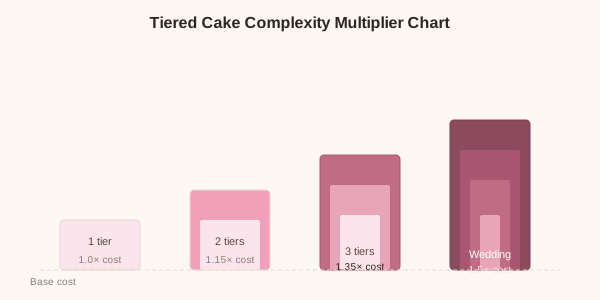
A complexity multiplier captures this. Rather than pricing each tier in isolation, you apply a multiplier to the assembled total that accounts for the non-linear work involved.
Typical multipliers:
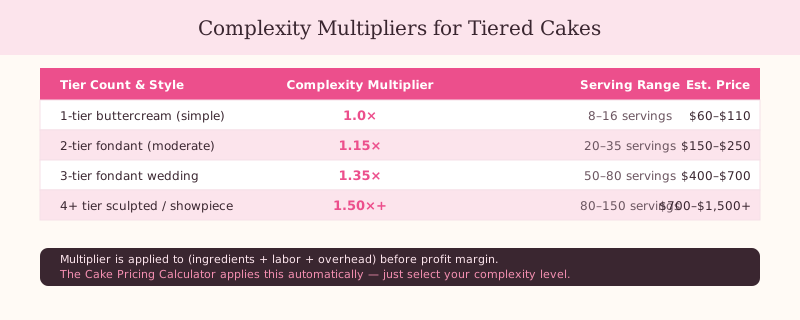
- 2-tier cake: 1.25–1.40× the sum of individual tier costs
- 3-tier cake: 1.35–1.55× the sum of individual tier costs
- 4+ tier cake: 1.50–1.75×, and you should seriously evaluate whether you want the job
Internal Support: The Cost of Making It Safe
Any tiered cake taller than a single layer needs internal support to hold the weight of upper tiers without the lower tiers collapsing. The options are:
Wooden or plastic dowels: The traditional method. A pack of 50 wooden dowels costs $6–$8, and a typical two-tier setup uses 6–8 dowels plus a central support. Material cost: approximately $1–$2 per tier.
Hollow plastic dowels with plate system: More stable, easier to level. A set of four hollow dowels with a separator plate runs $8–$12 per tier.
Stacked Plate System (SPS): The professional standard for heavy tiered cakes. A two-tier SPS kit costs $18–$30 and requires specific pans. It significantly reduces stacking risk but adds material cost.
Cake drums: A full-thickness (1/2 inch) drum board under each tier costs $1.50–$3.50 depending on size. These are not optional: soft boards compress under weight and cause the cake to lean.
A fully supported two-tier cake with SPS hardware and proper drum boards might add $20–$35 in materials alone. That comes before a single ingredient is costed.
Assembly Time: Where Hours Disappear
Stacking tiers is not a five-minute task. Done properly, it involves:
- Leveling each tier (15–20 min)
- Inserting supports, marking and cutting to height (20–30 min)
- Applying a fresh layer of frosting or ganache to the stacking surface (10–15 min)
- Lifting and positioning the upper tier (always nerve-wracking): 10–15 min
- Checking level with a small spirit level, adjusting if needed (5–15 min)
- Filling visible gaps at tier junctions with piping or fondant ribbon (20–40 min)
A realistic assembly time for a two-tier cake is 1.5–2 hours. A three-tier cake adds another 1–1.5 hours on top of that. At $25/hour, that's $37.50–$50 in labor before you've touched the decorating brush.
Transport Risk and the Price of Getting There in One Piece
Transporting a tiered cake is a source of real financial risk for the baker. A shift in transit, a sudden stop, or a turn taken at speed can all damage or destroy work that took hours to complete.
This risk should be priced in two ways.
First, charge for delivery time and mileage. If delivery takes 45 minutes round-trip, that's 0.75 hours at your labor rate plus $0.21/mile (current IRS rate). A 20-mile round trip at $25/hour plus mileage adds $18.75 + $4.20 = $22.95 to the order cost.
Second, consider a transport surcharge for large or fragile tiered cakes. A 3% surcharge on a $300 tiered cake is $9, a small amount that helps cover the occasional partial refund or re-do from transport damage.
Per-Tier Cost Buildup
Let's price a two-tier cake from the ground up: a 6-inch top tier and 9-inch bottom tier, both vanilla with buttercream, light fondant accents, and piped borders.
Bottom tier (9-inch, 2 layers):
- Ingredients: $14.80
- Consumables and packaging share: $2.50
- Labor (bake, fill, frost): 2.25 hours × $25 = $56.25
- Tier subtotal: $73.55
Top tier (6-inch, 2 layers):
- Ingredients: $9.40
- Consumables and packaging share: $1.50
- Labor (bake, fill, frost): 1.5 hours × $25 = $37.50
- Tier subtotal: $48.40
Sum of tier costs: $121.95
Hardware and support:
- SPS kit: $24.00
- Drum boards (2): $5.00
- Hardware subtotal: $29.00
Assembly and stacking:
- 1.75 hours × $25 = $43.75
Decorating (fondant accents, piped borders, finishing):
- 2 hours × $25 = $50.00
Delivery (15 miles round-trip, 40 minutes):
- 0.67 hours × $25 + 15 miles × $0.21 = $16.75 + $3.15 = $19.90
Subtotal before multiplier and margin:
$121.95 + $29.00 + $43.75 + $50.00 + $19.90 = $264.60
Complexity multiplier (2-tier, 1.30×):
$264.60 × 1.30 = $343.98
Overhead allocation (22%):
$343.98 × 0.22 = $75.68 → running total: $419.66
Profit margin (20%):
$419.66 × 1.20 = $503.59
Quoted price: $500–$510
That might look like a lot for a two-tier cake. But it reflects real costs: premium support hardware, 8+ hours of active work, delivery, and the complexity premium for work that can't be rushed. Run your own numbers through our cake pricing calculator to see how changes in tier count, labor rate, and complexity multiplier affect the final quote.
The 3-Tier Comparison
Using the same ingredient and labor rates, a 3-tier cake (adding an 8-inch middle tier) would add roughly:
- Ingredients and consumables: +$12.00
- Hardware (additional dowels, drum): +$8.50
- Additional stacking and leveling labor: +1.5 hours = $37.50
- Additional decorating: +1.5 hours = $37.50
That's +$95.50 in base costs before the 3-tier complexity multiplier (1.45×) and margins are applied. The final price for a comparable 3-tier cake typically lands 35–50% above the 2-tier price, not just the cost of one more tier.
Read the full wedding cake pricing guide for how these tiered structures translate into wedding-specific pricing, and see how to price a cake as a home baker for the foundational four-component pricing framework. Learn more about how this tool works before running your own numbers.
When to Decline a Tiered Cake Order
Not every order is right for every baker. Tiered cakes are among the most technically demanding work you'll take on. It's legitimate to decline if:
- The design requires skills or equipment you don't yet have
- The timeline doesn't allow for proper structure and setup
- The quoted price won't cover your real costs, and the client won't accept an accurate quote
- Delivery logistics are beyond what you can safely execute
Declining a job you can't profitably or safely complete is not a failure: it's good business judgment. A damaged or under-priced cake costs you more than the lost order.
Tiered cake pricing, done correctly, protects your time, your craft, and your reputation. Build it from the tiers up.