Bakery Overhead Explained: What to Include in Your Price
Bakery overhead expenses are the silent costs that eat your margins. Learn what counts, how to calculate your monthly total, and how to fold it into every cake price.
Quick Answer: Bakery overhead expenses are the operating costs not tied to a single cake order: electricity, insurance, equipment depreciation, packaging, and licenses. To price correctly, calculate your total monthly overhead, divide by your order volume, and add that per-cake overhead to every quote.
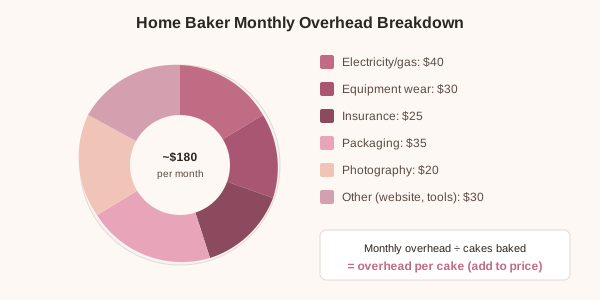
Most bakers who undercharge aren't ignoring their ingredient costs; they're ignoring everything else. You weigh your flour, calculate your butter, count your eggs. But do you charge for the electricity that ran your oven for two hours? The insurance that covers your home baking operation? The depreciation on a stand mixer that will eventually need replacing?
Bakery overhead expenses are the unglamorous side of running a baking business. They're real costs you pay every month whether you take an order or not, and if they're not in your price, they're coming out of your pocket.
What Is Overhead vs. a Direct Cost?
A direct cost is tied directly to one specific order. Ingredients are the clearest example: the flour and butter you buy for a birthday cake are consumed by that cake and nobody else's.
Overhead is every cost that supports your operation but doesn't belong to a single order. Your electric bill runs whether you bake one cake or twenty. Your insurance renews annually regardless of how busy the quarter was. These costs are real, and they need to be recovered through your pricing.
The distinction matters because overhead has to be allocated (spread across orders) rather than assigned one-to-one. That's the mechanism bakers most often skip.
The Full List of Bakery Overhead Items
Utilities
Electricity is usually the biggest utility cost for home bakers. A standard residential oven uses 2–2.4 kilowatts per hour. At the US average of $0.16/kWh, a two-hour bake costs roughly $0.64–$0.77 in electricity just for the oven. Add the stand mixer, lighting, refrigerator running continuously, and a dishwasher cycle, and a single cake order might consume $1.50–$2.50 in utilities.
If you use a gas oven, calculate your gas cost per therm and apply the same logic. Water costs are typically small ($0.20–$0.40 per order) but worth including.
Equipment Depreciation
Your stand mixer, oven, turntable, spatulas, pans, piping tips, airbrush kit: all of this will wear out and eventually need replacement. Depreciation is how you build that replacement cost into your pricing now, before the equipment fails.
A simple method: divide the purchase price of each major piece of equipment by its expected useful life in months. A $400 stand mixer expected to last 5 years (60 months) depreciates at $6.67/month. A $60 set of cake pans lasting 3 years (36 months) depreciates at $1.67/month. Add these up across all your equipment and you have a monthly depreciation total.
For most home bakers with a moderate equipment setup, depreciation runs $15–$40/month.
Insurance
If you sell baked goods, even from home, you need business liability insurance. A customer getting sick from your cake is not covered by a standard homeowner's policy. Home baker liability policies typically run $300–$600/year, or $25–$50/month.
If you're operating under a cottage food law in your state, check whether your state requires or recommends additional coverage.
Packaging Materials
Boxes, cake boards, ribbon, twist ties, plastic wrap, cellophane bags, tissue paper: everything you use to present and protect a finished order. Packaging is partly a direct cost (you know roughly how much packaging goes into each order) and partly overhead (you buy packaging in bulk and use it across many orders).
The cleanest approach: track what you spend on packaging over a month, then divide by orders. Most home bakers spend $30–$80/month on packaging materials depending on volume.
Licenses and Permits
Cottage food licenses, food handler certifications, local business licenses, and any food safety training courses all have fees. Divide your annual licensing costs by 12 to get a monthly figure. For most home bakers, this is $5–$20/month.
Software and Business Tools
Booking software, invoicing tools, design apps for custom cake mockups, accounting software: these all have subscription costs. If you pay $25/month for a suite of business tools, that's overhead.
Consumables You Don't Track Per Order
Dish soap, sponges, sanitizer spray, paper towels, gloves, foil, plastic wrap: the stuff you buy in bulk and use constantly but rarely think to charge for. Estimate your monthly spend and include it.
How to Calculate Your Monthly Overhead Total
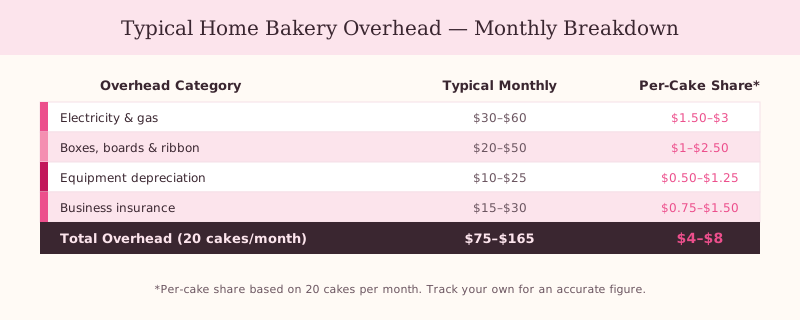
List every overhead category and assign a monthly dollar amount. Some items are fixed (insurance, licenses), some are variable but estimable (utilities), and some you'll need to track for a month to nail down (consumables, packaging).
Here's a realistic example for an active home baker doing 15–20 cakes per month:
| Overhead Item | Monthly Cost |
|---|---|
| Electricity (oven, mixer, fridge share) | $35 |
| Gas | $12 |
| Water | $8 |
| Equipment depreciation | $22 |
| Insurance | $38 |
| Packaging materials | $55 |
| Licenses and certifications | $10 |
| Software and business tools | $20 |
| Consumables (soap, gloves, paper towels) | $15 |
| Total Monthly Overhead | $215 |
At 18 cakes per month, that's $215 ÷ 18 = $11.94 overhead per cake.
Round up to $12 and add it to every order. It's not glamorous. But it's the difference between breaking even and actually building a sustainable business.
Converting Overhead to a Percentage for Flexible Pricing
Some bakers prefer to apply overhead as a percentage of ingredient cost rather than a flat dollar amount per order. This works well when order sizes vary widely: a flat $12 overhead makes more sense on a $80 cake than on a $400 wedding cake.
Overhead percentage formula:
Monthly overhead ÷ Monthly ingredient cost spend × 100
If you spend $800/month on ingredients and have $215 in overhead:
$215 ÷ $800 = 0.269 = 26.9% overhead rate
Apply that percentage to every order's ingredient cost to get a proportional overhead allocation. A cake with $20 in ingredients gets $5.38 in overhead. A cake with $60 in ingredients gets $16.14.
This method self-adjusts for order complexity, so bigger, ingredient-heavy cakes carry more overhead, which generally mirrors their actual resource usage.
A Worked Example: Full Overhead Calculation for One Order
Let's combine this with a real order. A customer wants a two-layer 8-inch carrot cake with cream cheese frosting and fresh walnut garnish.
Ingredient cost: $19.40 (calculated per the cost-per-unit method)
Overhead allocation: Using our 26.9% rate:
$19.40 × 0.269 = $5.22
Labor: 3.5 hours × $22/hr = $77.00
Subtotal: $19.40 + $5.22 + $77.00 = $101.62
Profit margin (20%): $101.62 × 1.20 = $121.94
Quoted price: $122
That overhead $5.22 looks small, but across 18 orders at a similar overhead allocation, you've recovered your $215 monthly cost. Skip it, and you pay it yourself every single month.
Use our cake pricing calculator to plug your overhead percentage directly into your pricing: it handles the allocation automatically once you enter your rate.
What Happens When You Don't Charge for Overhead
You still pay it. That's the only answer. Overhead isn't optional; it's the cost structure of your operation. If you don't recover it through pricing, it comes out of what you thought was profit, or out of your labor rate, or out of your own household budget.
This is why so many home bakers feel like they're "always busy but never ahead." They've priced the ingredients and their time, but not the business infrastructure that makes every order possible.
Reviewing and Updating Your Overhead
Overhead changes. If you upgrade your oven, add a new tool subscription, or your insurance premium renews at a higher rate, your overhead figure goes up. Review it every quarter or whenever you make a major purchase.
Also revisit your per-cake overhead allocation when your order volume changes significantly. If you scale from 18 cakes to 30 cakes a month, your per-cake overhead drops even if your total overhead stays the same, which is one of the genuine benefits of higher volume.
Read the guide to setting your hourly rate as a baker to learn how overhead and labor work together in your final price. And learn more about how this calculator was built to see how all these components combine into a clean, accurate quote.
The bakers who run profitable operations at any scale are the ones who see overhead not as a hidden cost, but as a line item they control.