How to Set Your Hourly Rate as a Baker
Most bakers set their hourly rate by feel and end up underpaying themselves. Here is how to calculate the baker hourly rate your income goals actually require.
Quick Answer: To set your baker hourly rate, start with your annual income goal, divide by your realistic billable hours per year, then adjust for your skill level and local market rates. Most home bakers fall in the $15–$35/hour range; experienced cake artists charge $40–$60+.
Here's a scenario most bakers recognize: you finish a four-hour decorating session on a custom celebration cake, pack it up, deliver it, and come home with $60 after ingredients. That works out to $15/hour, before taxes, before overhead, before the time you spent on client emails and ingredient runs. The actual hourly rate is something more like $8.
This isn't a rare situation. It's the default for bakers who set their hourly rate by feel rather than by math. Fixing it starts with one honest calculation.
Why Most Bakers Underpay Themselves
There are three reasons bakers consistently set their rates too low.
The first is comparison to other bakers' visible prices. You look at what other home bakers in your area charge and anchor to a similar number, even if that baker is also undercharging.
The second is discomfort with the number. Charging $25/hour for your work feels presumptuous if you haven't thought of yourself as a professional. It isn't. Decorating a wedding cake requires real skill, and skill earns a professional rate.
The third is not knowing what a rate needs to cover. A $20/hour rate sounds reasonable until you realize it has to cover labor and contribute to taxes, slow weeks, business costs, and eventually retirement. When you account for all of that, the target rate looks very different.
The 3 Factors That Determine Your Rate
Factor 1: Your Skill Level and Specialization
An entry-level home baker producing simple sheet cakes commands a different rate than a trained pastry chef creating sculpted fondant showpieces. That's not judgment; it's market reality.
Think about what you actually offer: years of training, specialized techniques, consistency under pressure, the ability to execute complex designs. The more specialized your work, the higher your rate can justifiably go.
As a rough guide:
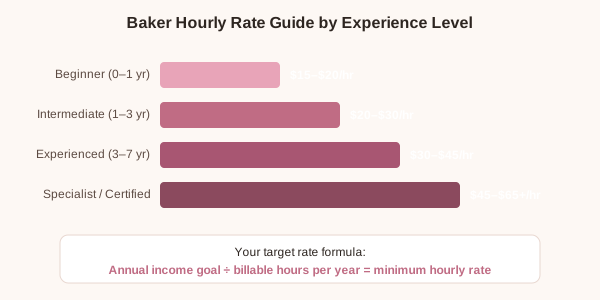
- Starting out (under 2 years, basic decorating): $15–$20/hour
- Intermediate (2–5 years, piping, fondant, custom designs): $20–$30/hour
- Experienced (5+ years, tiered cakes, sculpted work, consistent delivery): $30–$45/hour
- Specialist/artisan (advanced sugar work, wedding cakes, niche skills): $45–$60+/hour
These are ranges, not ceilings. Your local market will shift them in either direction.
Factor 2: Your Local Market
Rates that are standard in New York City are aspirational in a rural county. Before you set a number, check what comparable bakers in your area charge for similar work. Look at their menus if they're public-facing, or connect with local baker communities where pricing discussions happen.
Don't race to the bottom. But do understand the range your customers have been exposed to. Pricing 40% above the local ceiling requires either exceptional work or exceptional marketing, preferably both.
Factor 3: Your Income Goal
This is the factor most bakers skip entirely, and it's the most important one. Your rate needs to support your financial life, not just cover the time you spend decorating.
Start by asking: how much do I need (or want) to earn from baking this year?
How to Calculate Your Target Rate
The formula:
Hourly rate = Annual income goal ÷ Annual billable hours
"Billable hours" are the hours you can actually charge clients for across the year. Not every hour you work is billable, and we'll address that below.
Step 1: Set your annual income goal.
Let's say you want to earn $28,000/year from baking.
Step 2: Estimate your annual billable hours.
You bake 40 weeks per year (allowing for vacations, slow periods, holidays). You average 20 billable hours per week.
Annual billable hours = 40 × 20 = 800 hours
Step 3: Calculate the base rate.
$28,000 ÷ 800 hours = $35/hour
Step 4: Adjust for taxes.
Self-employment tax in the US is 15.3% on top of income tax. To net $35/hour, you need to bill more. A simple rule: gross up your rate by 25–30% to account for taxes and unpaid time.
$35 × 1.28 = ~$45/hour
That $45/hour target might feel high. But it's the rate required to actually net $28,000 after taxes, given your volume. If you charge $20/hour instead, you'll earn roughly $14,000, not $28,000.
Use our cake pricing calculator to test how different labor rates change the final price of your typical orders: it's a quick way to see whether your current rate is anywhere near what the math requires.
What "Billable Hours" Really Means
Billable hours are the hours clients pay for directly. That means active baking time, decorating time, setup, and customer-facing time like delivery and tastings.
What billable hours do not include:
- Shopping and ingredient runs: You need to shop to bake, but you typically can't charge a specific client for a grocery run that also covered your household needs.
- Bookkeeping and admin: Time spent on invoices, scheduling, and social media is real work but not chargeable per order.
- Skill building: Time watching tutorials or practicing new techniques is an investment, not billable time.
- Equipment maintenance and cleaning beyond the order: A deep clean of your kitchen isn't charged to last week's client.
For every 1 hour of billable work, most home bakers spend 30–45 minutes on non-billable tasks. When you estimate 20 billable hours per week, your real working time is closer to 28–30 hours. Factor this into your income expectations, and into how many orders you're realistically willing to take on.
Rate Ranges by Experience Level
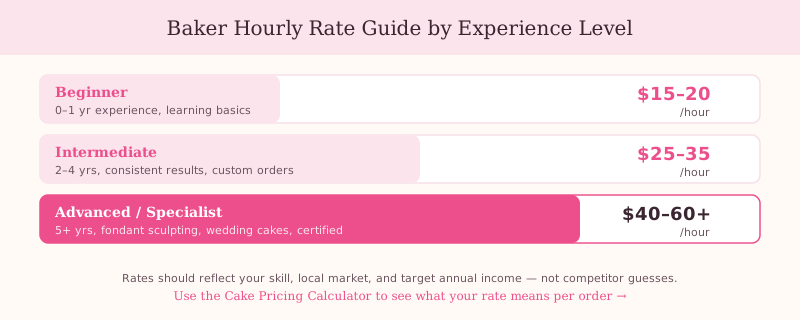
Here's a more detailed view of how rates typically break down, accounting for the real-world overhead and tax burden bakers carry:
| Experience Level | Billable Rate | Notes |
|---|---|---|
| Entry level (0–2 years) | $15–$20/hr | Learning stage; basic cakes |
| Home baker (2–4 years) | $20–$28/hr | Custom designs, reliable output |
| Semi-professional (4–7 years) | $28–$40/hr | Tiered cakes, specialty work |
| Professional artisan (7+ years) | $40–$60+/hr | Wedding cakes, advanced techniques |
These are for actual labor hours. The final cake price also includes ingredients, bakery overhead expenses, and a profit margin; your hourly rate is just one component.
Raising Your Rate With Existing Clients
Eventually, your skills improve, your costs rise, or your rate simply needs to reflect your true market value. Raising rates on clients who've been paying the old price is awkward, but necessary.
A few principles that make it easier:
Give notice. Tell regular clients 4–6 weeks before the new rate takes effect. This lets them plan and doesn't feel like a surprise at checkout.
Be matter-of-fact about it. "Starting in June, my prices will increase to reflect updated ingredient costs and my current rate structure" is all you need to say. No elaborate explanation required.
Hold the line. If you announce a rate increase and then fold immediately when someone pushes back, you've undermined your own credibility. Some clients will leave. The ones who stay are your real customers.
Raise on new clients first. When you're uncertain, test the higher rate with new clients before rolling it out to long-term regulars. If new bookings hold at the higher rate, you have confidence before the harder conversation.
Read how to price a cake as a home baker to see how your hourly rate combines with ingredients and overhead in a full price calculation, and check our about page to learn more about how the pricing tool handles these inputs.
Your Rate Is a Business Decision
There's nothing selfish about charging what your work is worth. Your rate supports your ability to keep baking, invest in better equipment, develop new skills, and show up consistently for your clients.
A baker who prices correctly is a baker who stays in business. And a baker who stays in business keeps getting better at the craft.
Figure out your actual target rate, plug it into a real order calculation, and see what your cakes should sell for. The number might surprise you, and that surprise is worth acting on.