How to Calculate Cake Ingredient Costs Accurately
Learn how to track cake ingredient costs down to the last gram so rough estimates stop eating your profits on every order.
Quick Answer: To calculate cake ingredient costs accurately, price every ingredient by weight or volume, divide the package cost by the total units it contains, then multiply by the exact amount you use in the recipe, including partial use of large packages.
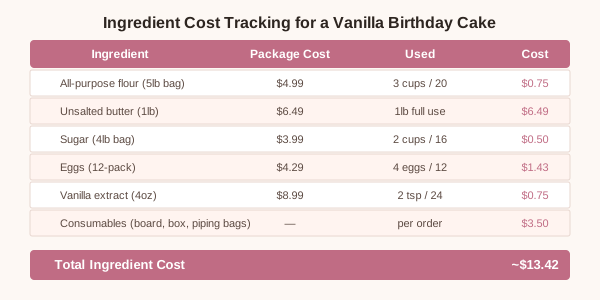
Rough estimates are the number-one reason home bakers and small bakeries lose money on orders they thought were profitable. You make a gorgeous six-inch vanilla layer cake, charge what feels fair, and then wonder at the end of the month why your bank account looks thinner than your sponge layers. The answer is almost always in the ingredient math.
Getting cake ingredient costs right is not complicated once you have a system. It takes about 20 minutes to set up a spreadsheet, and it pays back every single time you quote an order.
Why "Ballpark" Ingredient Estimates Kill Your Margins
Most bakers who guess at ingredient costs underestimate by 30–50%. They remember the sticker price on a bag of flour but forget to account for the butter they opened a second pack for, the vanilla extract that costs $18 a bottle, and the three sheets of parchment paper they burned through.
Every ingredient you eyeball instead of measure is money slipping out of your pricing. If you're underestimating ingredients by $4 on a $45 cake, that's roughly 9% of your sale price gone before you've even counted your time. Multiply that across 20 orders a month and you've lost $80 in ingredient costs alone.
The fix is a cost-per-unit system. You price every ingredient by its smallest measurable unit (per gram, per teaspoon, per sheet) and you use that rate every time you cost a recipe.
The Cost-Per-Unit Method
The formula is simple:
Cost per unit = Package price ÷ Number of units in the package
Then for each recipe:
Ingredient cost = Cost per unit × Units used in recipe
Here's how that looks in practice. A 5 lb bag of all-purpose flour costs $4.29. Five pounds equals 2,268 grams. So your cost per gram of flour is $4.29 ÷ 2,268 = $0.00189 per gram, or roughly $0.19 per 100 grams.
If your vanilla cake recipe uses 300 grams of flour, that line item costs you $0.57.
Do this for every ingredient. It sounds tedious the first time, but once your spreadsheet is built, costing a new recipe takes five minutes.
Tracking Partial Use of Large Packages
The trickiest part of ingredient costing is handling packages you only partially use. A 2 lb bag of powdered sugar, a quart of buttermilk, a tub of shortening: these get opened, partially used, and sit in the pantry. Bakers often forget to charge for them because the package isn't "used up."
The cost-per-unit method solves this automatically. You don't charge for the package; you charge for the amount you used. So if your frosting recipe needs 450 grams of powdered sugar and your 907-gram bag cost $3.49, you charge:
($3.49 ÷ 907) × 450 = $1.73 for that bag of powdered sugar
The remaining 457 grams stays in your pantry at zero cost to that order. Its cost will be captured when you use it on a future order.
What to Do With Ingredients You Buy in Bulk
Bulk buying changes the math in your favor but only if you update your spreadsheet. If you switch from a 2 lb bag of flour to a 25 lb bag, recalculate your cost per gram. Bulk pricing typically cuts ingredient costs by 15–25%, which is real money at volume.
Track the date you update ingredient prices too. Food costs fluctuate, and butter in particular can swing $0.50–$1.00 per pound between seasons. Review your ingredient prices every 60–90 days.
Don't Forget Consumables
Consumables are the silent margin killers most bakers overlook entirely. These are supplies that go into or with every order and cost real money:
- Parchment paper: A roll of 100 sheets costs ~$12, so each sheet is $0.12. A standard two-layer cake uses 2–3 sheets = $0.24–$0.36.
- Piping bags: Disposable bags run $0.15–$0.25 each. A complex decorated cake might use 6–8 bags = $1.20–$2.00.
- Cake boards: A 6-inch foil board costs $0.40–$0.60. A 10-inch drum board can cost $1.50–$2.50.
- Cake boxes: Standard boxes run $1.00–$3.00 depending on size and style.
- Plastic wrap, aluminum foil, twist ties: Estimate $0.20–$0.40 per order.
A fully packaged cake order can have $3–$6 in consumables alone. If you're not charging for them, they're coming out of your profit.
Add a "consumables" line to every recipe cost sheet. For most 6–8 inch cakes, $3.00–$4.00 covers standard packaging materials. Adjust up for premium boxes or custom packaging.
Worked Example: Vanilla Birthday Cake Ingredient Cost
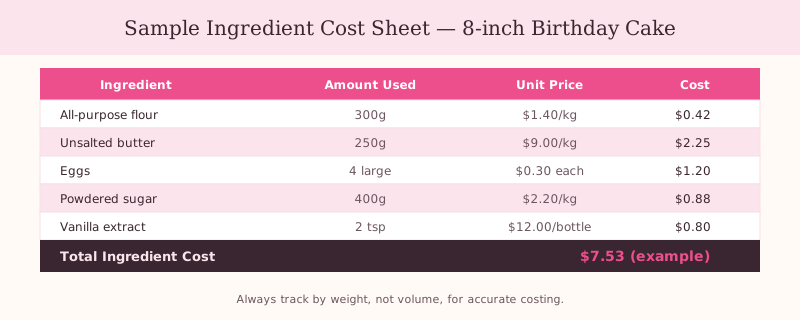
Let's cost a standard 8-inch, two-layer vanilla birthday cake with vanilla buttercream frosting. All package prices are current retail.
Cake Layers
| Ingredient | Amount Used | Package Cost | Package Size | Line Cost |
|---|---|---|---|---|
| All-purpose flour | 360g | $4.29 | 2,268g | $0.68 |
| Granulated sugar | 300g | $2.99 | 2,268g | $0.40 |
| Unsalted butter | 226g | $5.49 | 454g | $2.73 |
| Large eggs (4) | 4 eggs | $4.49 | 12 eggs | $1.50 |
| Whole milk | 240ml | $3.79 | 1,892ml | $0.48 |
| Baking powder | 8g | $3.29 | 113g | $0.23 |
| Salt | 3g | $1.49 | 737g | $0.01 |
| Pure vanilla extract | 10ml | $18.00 | 118ml | $1.53 |
Cake layer subtotal: $7.56
Vanilla Buttercream Frosting
| Ingredient | Amount Used | Package Cost | Package Size | Line Cost |
|---|---|---|---|---|
| Unsalted butter | 226g | $5.49 | 454g | $2.73 |
| Powdered sugar | 480g | $3.49 | 907g | $1.85 |
| Heavy cream | 60ml | $4.29 | 473ml | $0.54 |
| Vanilla extract | 5ml | $18.00 | 118ml | $0.76 |
| Salt | 1g | $1.49 | 737g | $0.00 |
Frosting subtotal: $5.88
Consumables
| Item | Cost |
|---|---|
| Parchment paper (3 sheets) | $0.36 |
| Piping bags (4) | $0.80 |
| 8-inch cake board | $0.55 |
| Cake box | $1.75 |
Consumables subtotal: $3.46
Total Ingredient Cost: $16.90
This vanilla birthday cake has a true ingredient cost of $16.90. If you were eyeballing it at "$10 in ingredients," you were undercharging by $6.90 per cake before counting your time, overhead, or profit margin.
Use our cake pricing calculator to plug these ingredient costs in alongside your hourly rate and overhead to get a complete price: not just what the ingredients cost, but what the cake should sell for.
Building Your Ingredient Cost Spreadsheet
Set up one tab per base recipe. Each row is an ingredient with these columns: Ingredient name, Package cost, Package size with unit, Cost per unit (formula: col B ÷ col C), Amount used, Line cost (formula: col D × col E).
At the bottom, sum the line costs for your total ingredient cost. Add a second table for consumables with the same structure.
Once you build this once, updating it when prices change takes two minutes. And when you want to calculate the full cost of a custom cake, your ingredient number is already accurate, not a guess.
When Ingredient Costs Change
Dairy and eggs are the most volatile. Butter prices can shift 20–30% in a quarter. When ingredient costs change, update your spreadsheet first, then recalculate any standing order prices. If a client wants to reorder the same cake six months later, pull fresh numbers before quoting.
The team at our about page built this calculator specifically to handle cases where ingredient costs, labor, and overhead all need to combine cleanly into a final price.
Putting It All Together
Accurate cake ingredient costs are the foundation of profitable pricing. The cost-per-unit method handles partial package use cleanly, consumables tracking closes the gap most bakers miss, and a simple spreadsheet makes it repeatable.
Once you know your real ingredient cost, you can add your labor and overhead on top with confidence. Check out how to price a cake as a home baker for how those three numbers combine into a final price, and bakery overhead expenses explained for building out that overhead figure accurately.
The bakers who price profitably are almost never the ones with the best recipes. They're the ones who know their numbers.